Progress-State Bell Toy in Natural Mathematics
Progress-State Bell Toy
A Bell-style toy model is constructed from a primitive state built from sector and progress,
where denotes the current orientation sector and denotes progress through that sector. The construction treats binary state and state progress as the fundamental variables. The sector label supplies the observable state, while tracks advance toward the next flip.
An earlier exploratory draft introduces the orientation-based language of Natural Mathematics in heuristic form. The present note does not rely on the full axiomatic programme. It isolates one minimal sector-progress structure inspired by that draft and studies its consequences as a local Bell-style toy model.
Update Rule
Given a progress increment , the state is updated through
with total progress
flip count
and remainder
The updated sector is
The updated state is therefore . Progress accumulates continuously within a sector, and each boundary crossing flips the sector while preserving the remainder. When several boundaries are crossed in one update, only the parity of the number of crossings determines the final sector.
Example Updates
The update rule behaves as expected in simple test cases:
These examples confirm the intended behaviour: persistence within a sector, flipping on overflow, and retention of the remainder after the flip.
Binary Measurement Rule
The toy uses the simplest binary observable,
so the sector itself supplies the readout.
Bell Construction
A shared source emits pairs with common hidden variables: an initial sector , an initial progress , and a shared latent parameter . Each wing then evolves locally according to its own setting.
The hidden-variable space is taken to be
with sampled uniformly from , , and . These source variables are taken to be statistically independent of the measurement settings.
For settings on one wing and on the other, local progress increments are defined by
Each wing updates independently, and the resulting outcomes are correlated in the usual CHSH form.
The correlations are computed as
and the CHSH combination is
Local Response Rule
A piecewise local response rule is introduced. Let
where returns angular separation on . The local progress increment is taken to be
The parameter therefore sets the width of the local response window. Local alignment produces strong progress, while non-alignment produces weak progress.
Analytic Correlation Lemma
Because both wings share the same hidden source state, the product of the two binary outcomes depends only on the parity mismatch between the two local overflow counts. Writing
one can make the mechanism completely explicit.
Lemma
Assume and . Then
Proof
For fixed , each floor term is either or . A parity mismatch occurs exactly when one of the two quantities crosses the overflow threshold and the other does not. Since is uniform on , the set of mismatch values has measure . Therefore the product equals on a set of that measure and elsewhere, giving the stated conditional expectation.
Averaging over the shared hidden variable yields
This expression shows that the Bell-type structure is controlled by the average mismatch in local progress increments under the shared hidden variable .
For the specific two-level rule used here, , so
and therefore
The correlations are thus determined by the extent to which the two local response windows disagree as functions of .
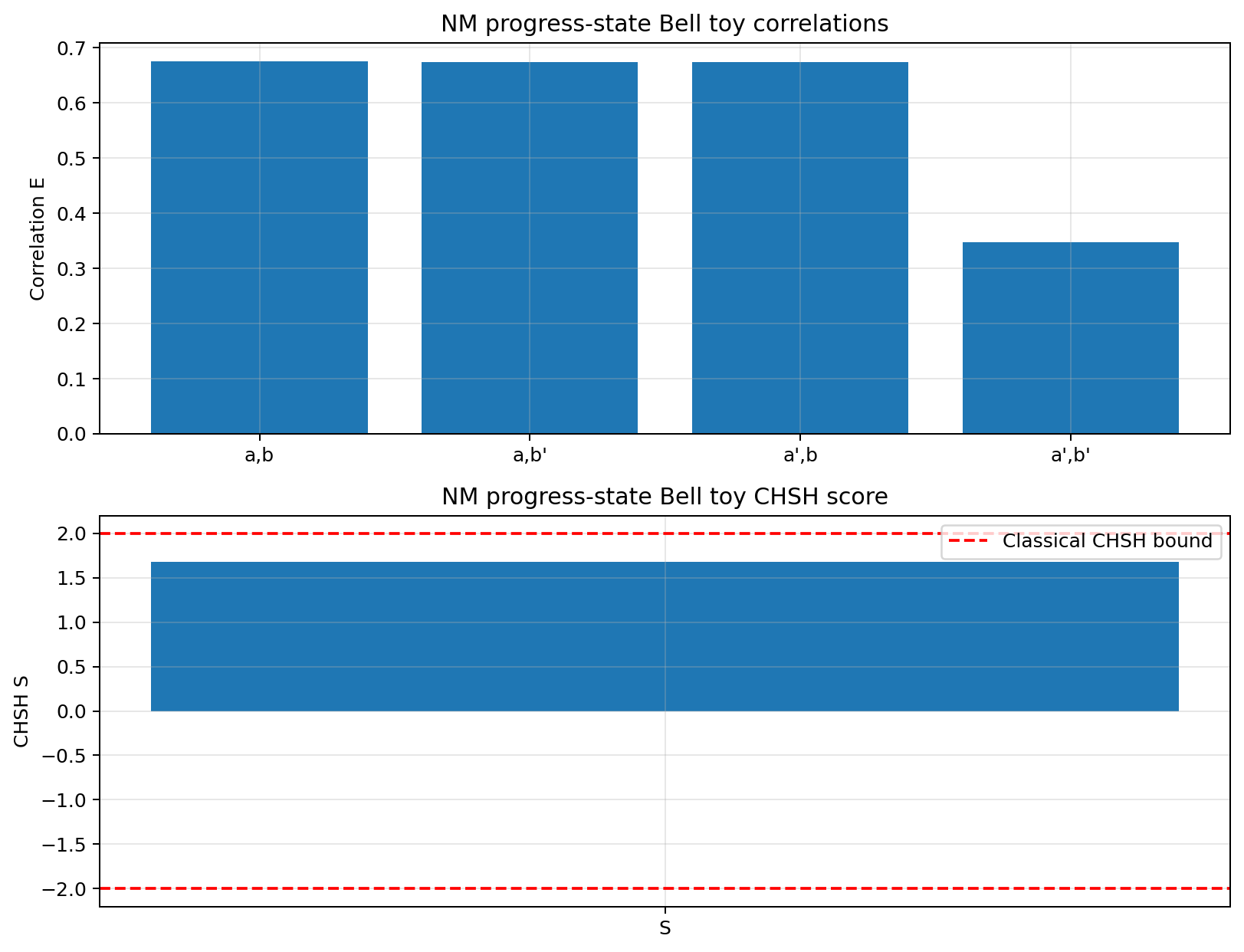
Figure 1: Representative progress-state Bell toy result for a fixed local response window. Top: the four Bell-setting correlations. Bottom: the corresponding CHSH score. Numerical values shown here and below are estimated by Monte Carlo sampling of under the stated uniform source distribution.
Classicality
For each hidden state , the toy assigns deterministic local binary outcomes . The construction therefore lies within the standard local hidden-variable class, and the CHSH bound
follows by the usual theorem. The numerical sweep therefore illustrates how the response-window parameter moves the toy within the classical region.
Width Sweep
To test robustness, the response width is swept across four values:
The corresponding CHSH scores are
The CHSH score rises monotonically across the sweep. The response window therefore supplies a genuine control parameter for the toy.
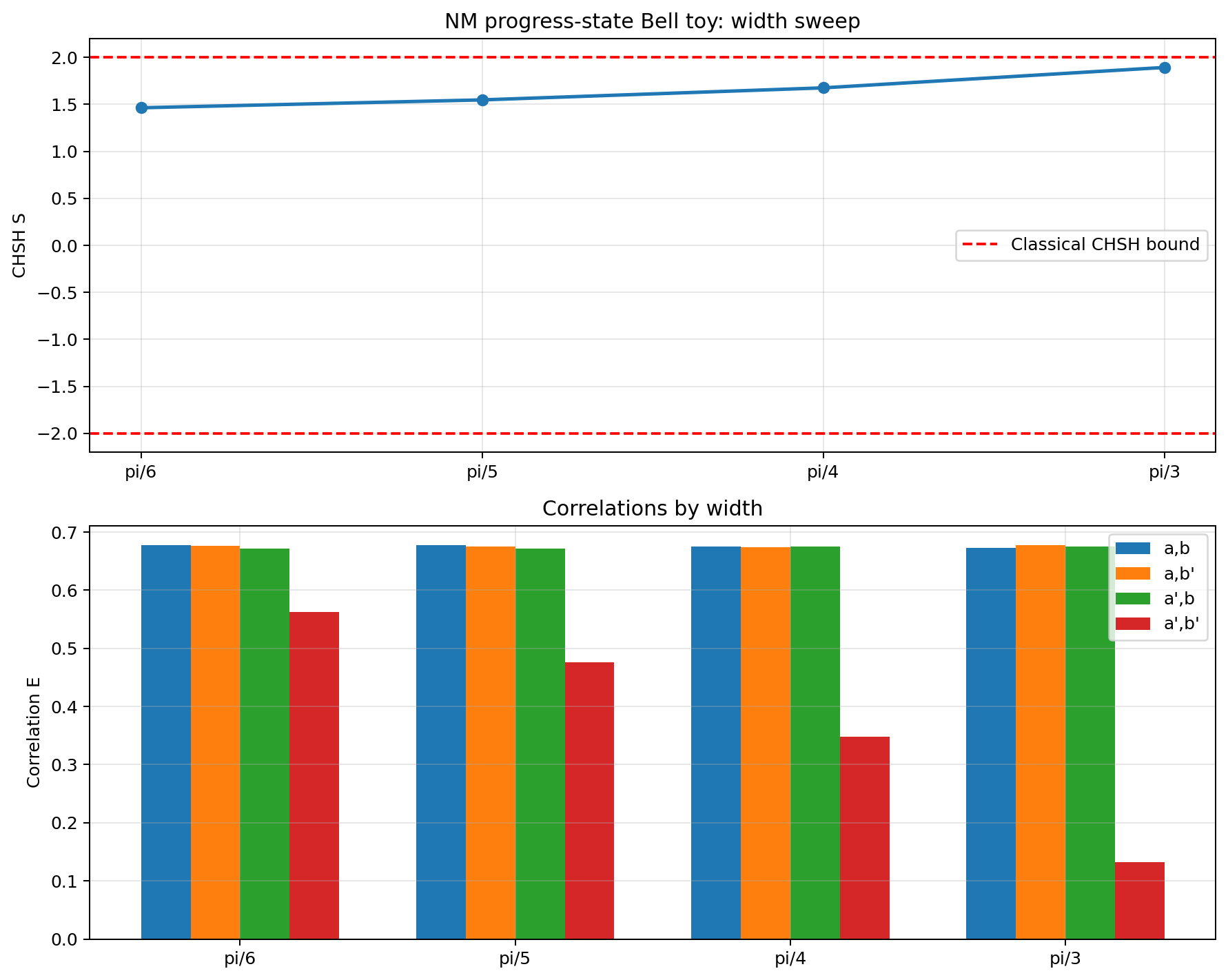
Figure 2: CHSH score as a function of response-window width for the progress-state Bell toy. Top: CHSH score across the width sweep. Bottom: the four setting-pair correlations across the same sweep. The score rises from at to at , approaching but not exceeding the classical bound.
Correlation Pattern
The increase in does not arise from all four correlations growing together. The three channels , , and remain clustered near across the sweep. The main change occurs in the channel, which falls steadily:
- at
- at
- at
- at
The rise in is therefore driven by one setting pair becoming progressively more exceptional than the other three. In the language of the analytic reduction above, this is the setting pair for which the two local response windows disagree most strongly as functions of .
Diagnostic Behaviour
Across the sweep, the mean progress increments and mean flip counts change only modestly. The dominant change appears in the same-sector agreement for the channel. The width parameter therefore alters the pattern of sector agreement more strongly than the overall level of activity.
Interpretation
The progress-state Bell toy shows that a minimal sector-progress algebra, written in Natural Mathematics language as , supports a local Bell-style model with binary measurements and non-trivial setting-dependent correlations.
- The formalism supplies a working local update algebra with explicit binary readout.
- The Bell-type structure depends strongly on the local response rule. The piecewise response preserves the sector structure clearly enough to produce a monotonic CHSH trend across the width sweep.
- Widening the local response window drives the CHSH score upward toward the classical ceiling by suppressing one correlation channel while leaving the other three relatively stable.
The toy remains classical throughout the tested sweep. No Bell violation occurs. The result instead demonstrates that local sector-progress dynamics are sufficient to generate a structured and tunable Bell-type landscape.
Summary
The progress-state Bell toy provides a clean checkpoint for the toy phase. A primitive state space built from sector and progress, together with a flip-on-overflow update law, generates structured CHSH-style correlations under fully local rules. The score rises from approximately to as the local response window widens from to , while remaining below the classical bound.
Interactive Bell Toy
Further Reading
Code and Reproducibility
The analysis pipeline used in this study is implemented in Python. All code used to generate the figures and statistical results presented in this work is available as open-source software:
github.com/hasjack/OnGravity/tree/main/python/bell-toy
This repository includes the full analysis pipeline, data ingestion routines, model fitting procedures, and scripts used to generate the figures presented in this paper.

Please consider funding this research on Research Hub
Content on this site is licensed under a Creative Commons Attribution 4.0 International License